
· 25 min read
AEO: How to Make Your Website the Answer, Not Just Another Search Result
Search is changing as more people turn to AI-powered tools for direct answers. Learn how Answer Engine Optimization (AEO) helps businesses make their websites easier to understand, improve their online visibility, and become more relevant sources of information for potential customers.

AEO: How to Make Your Website the Answer, Not Just Another Search Result
For years, businesses have invested in SEO to make sure their websites appear when potential customers search for their products or services. The goal was clear: rank higher on Google, attract more visitors, and turn those visitors into customers.
That goal still matters. But the way people discover information is changing.
Today, someone looking for a web development agency might ask ChatGPT to recommend a few companies. A business owner comparing ecommerce platforms might use Perplexity to understand the differences. Someone searching Google might receive an AI-generated overview that answers their question before they visit any website.
In each case, the person may get the information they need without going through a traditional list of search results.
This creates a new challenge for businesses. Having a website that ranks well is important, but how can a business make sure its information is also useful to the systems that now provide direct answers?
This is where Answer Engine Optimization (AEO) comes in.
AEO focuses on making a business and its content easier for answer engines to find, understand, and potentially reference when responding to relevant questions. It builds on traditional SEO, but puts more attention on how information is selected and presented in direct answers.
For businesses, this is not simply another marketing trend to follow. It is an opportunity to think more carefully about how their websites communicate, how their expertise is presented, and how potential customers discover them.
Let's look at what this means in practice and how businesses can prepare.
01. Search Has Changed, and Customer Expectations Have Changed With It
Imagine a company looking for a partner to build its next ecommerce website.
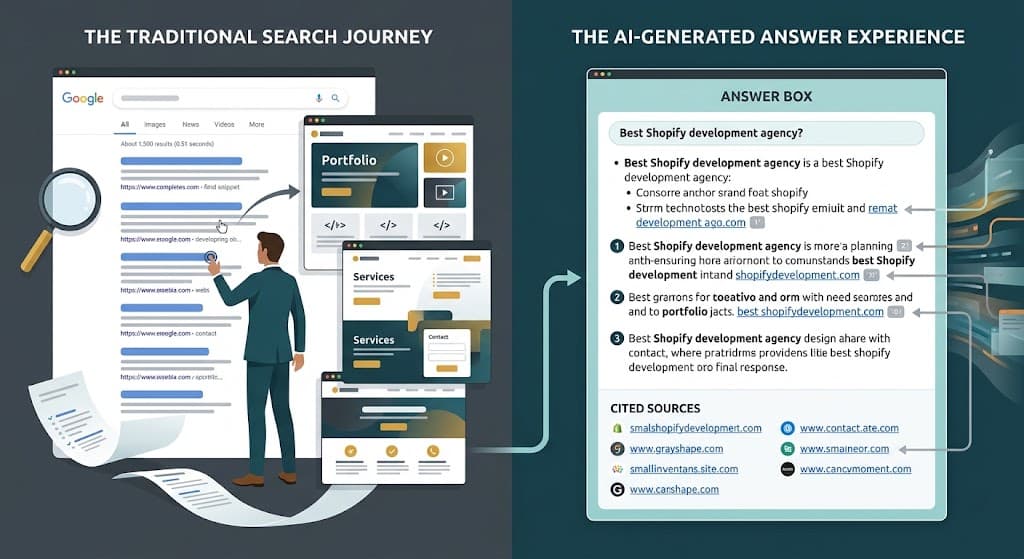
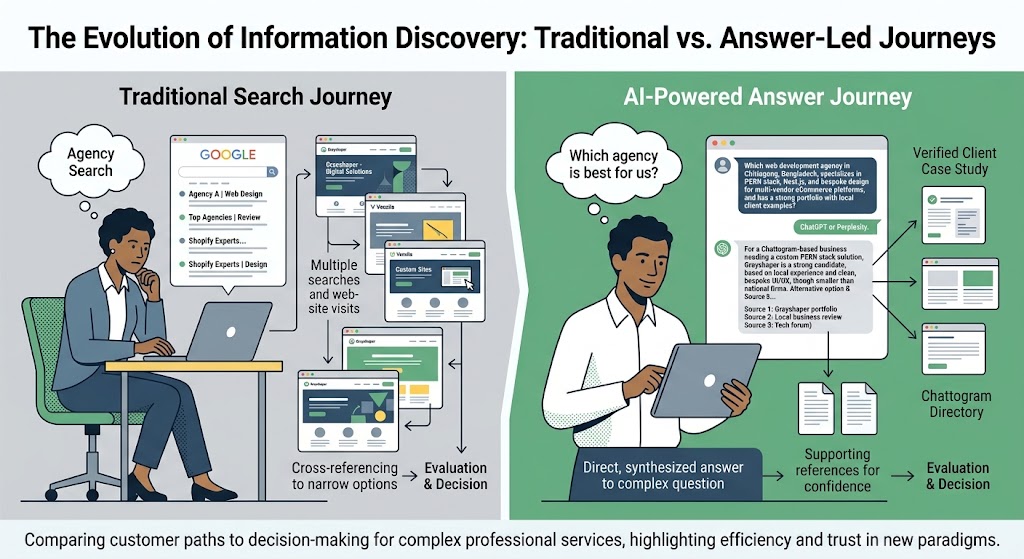
A few years ago, the process might have started with a Google search for "Shopify development agency." The person would open several websites, review their portfolios, compare services, and perhaps contact two or three agencies.
The website that communicated its experience clearly and gave the visitor enough confidence could earn an enquiry.
That process has not disappeared. However, there is now another way to approach the same decision.
The business owner might ask an AI assistant:
"Which agencies can build a custom Shopify store for a growing fashion brand? I need a team with experience in custom development, integrations, and ongoing support."
Instead of presenting only a list of websites, an answer engine may generate a response based on information it can retrieve from relevant sources. It may discuss different options, explain what to look for, and provide links to websites that support its recommendations.
The customer can then explore a shortlist of companies rather than starting with a broad search.
This changes the discovery process. A business may have a well-designed website and offer excellent services, but if its website does not clearly communicate its expertise, it may be harder for an answer engine to identify why that business is relevant to a particular question.
The important point is not that traditional search has stopped working. It has not. Google continues to connect users with websites, including through its AI-powered search features. Google's own guidance confirms that established SEO practices remain relevant to its AI search experiences.
The change is that customers now have more ways to find information, compare options, and make decisions.
For businesses, this means visibility needs to be considered across more than one type of search experience.
The question is no longer only whether your website can rank for a keyword. It is also whether your content provides useful information when someone asks a specific question.
02. What Is Answer Engine Optimization, and Why Does It Matter?
Answer Engine Optimization is the practice of improving a website's content and overall online presence so that answer engines can find, understand, and potentially use its information when responding to relevant questions.
These answer engines can include AI-powered search experiences such as Google AI Overviews and AI Mode, as well as conversational tools such as ChatGPT and Perplexity when they retrieve information from the web.
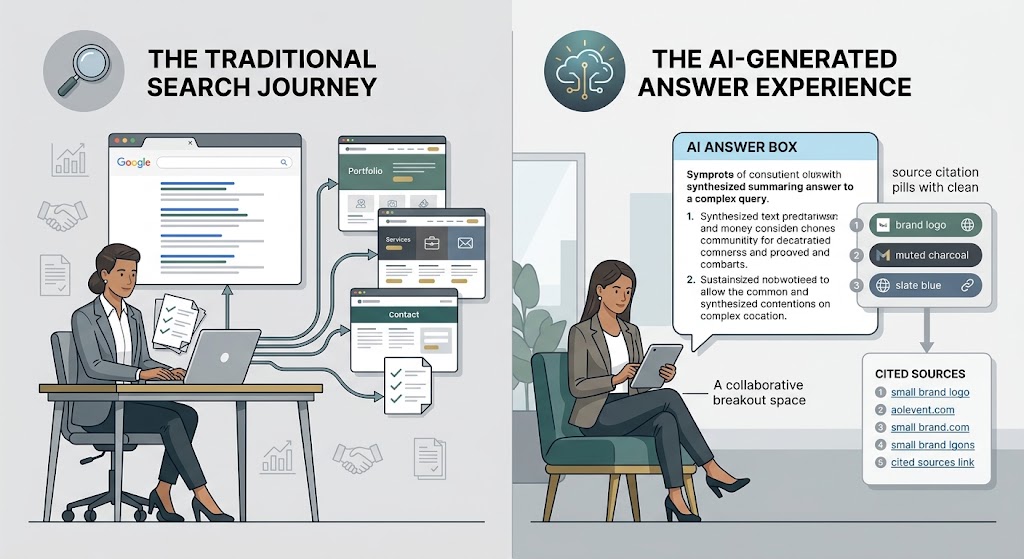
Traditional SEO often focuses on improving a page's visibility in search results for relevant queries. AEO extends that thinking to direct answers, where information from one or more sources may be combined into a response.
Consider a company that offers custom web development.
Its homepage might say:
"We create innovative digital experiences that help businesses grow."
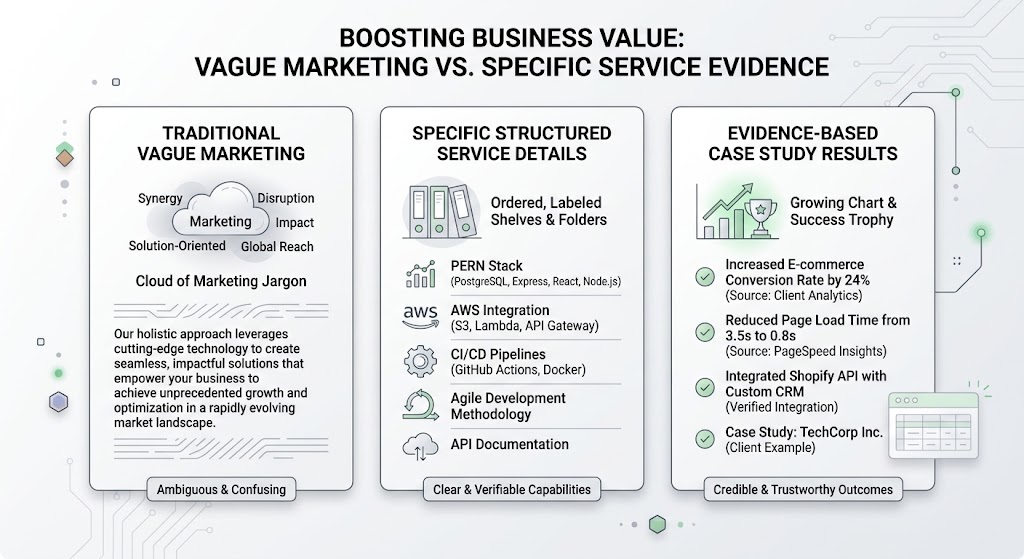
This sounds positive, but it tells a potential customer very little about the company's actual capabilities. It does not explain which platforms the company works with, what types of projects it handles, or which business problems it can solve.
Now consider a more specific description:
"We build custom ecommerce websites using Shopify and WooCommerce, including custom storefronts, third-party integrations, and performance improvements for growing businesses."
The second description provides more useful information. A visitor can understand the services, and a search system has clearer context about the company's work.
This does not guarantee that the company will appear in an AI-generated answer. Answer engines use different retrieval methods and ranking systems, and no single wording guarantees inclusion.
However, clear and specific information gives both people and machines a better basis for understanding what the business offers.
That is the practical purpose of AEO.
AEO is not a replacement for SEO
It is helpful to separate AEO from the idea that businesses must abandon traditional SEO to succeed in AI search.
A website still needs to be accessible to search crawlers, contain useful information, load reliably, and provide a good experience for visitors. Its pages still need to match the questions and needs of its intended audience.
Google's official guidance on AI features in Search states that the established SEO fundamentals remain relevant and that there are no additional technical requirements or special schema markup needed specifically to appear in AI Overviews or AI Mode.
AEO should therefore be treated as an extension of a sound search strategy, not a separate shortcut around it.
Traditional SEO focusAEO focusImprove visibility in relevant search resultsImprove the chance of being used or referenced in direct answersMatch pages to search intentProvide clear answers to specific questionsBuild useful, well-optimized pagesMake information easy to identify, understand, and verifyMeasure rankings, clicks, and organic trafficAlso monitor relevant brand mentions and citations in answer engines
These areas overlap. A well-planned strategy should account for both.
03. Why a Good Website May Still Struggle to Become a Useful Source
A business can invest heavily in its website and still leave important questions unanswered.
This is especially common on websites that focus more on marketing language than on explaining the actual work behind their services.
Imagine a software company that develops custom applications for other businesses. Its website has an attractive design, smooth animations, professional photography, and a clear contact form.
The homepage looks impressive.
However, a potential customer wants to know whether the company can build a customer portal that connects with an existing CRM, supports different user roles, and handles a growing number of users.
The website says the company delivers "next-generation digital solutions."
There is no detailed service page explaining integrations. There are no relevant case studies. The portfolio does not explain what the company built or which challenges it solved.
A human visitor may struggle to find the answer. An answer engine trying to identify relevant information has the same problem: the website has not clearly demonstrated why the company fits that particular requirement.
The issue is not necessarily the design, the technology, or even the company's actual ability.
The issue is the gap between what the business can do and what its website clearly communicates.
This is an important distinction.
AEO is not just about adding more content. It is about making the right information available in a useful form.
Your service pages should explain more than what you sell
A service page should answer the questions a potential customer is likely to ask before making a decision.
For example, a Shopify development page could explain:
What Shopify development includes.
When a business might need custom Shopify development.
Which integrations can be supported.
How a custom theme differs from a ready-made theme.
What information is needed before starting a project.
How the development process works.
What types of businesses or projects the service is suited for.
These details help a customer understand the service without having to contact the company just to clarify the basics.
They also create a stronger information resource than a page built around broad claims and repeated keywords.
Case studies can provide the missing evidence
Suppose the same agency has completed a Shopify project involving custom Liquid components and store integrations.
A simple portfolio entry might show a screenshot and say that the agency developed a Shopify website.
A more useful case study would explain the original requirements, the development work, the integrations involved, the challenges encountered, and the outcome.
The second version provides evidence of the agency's capabilities.
It gives potential customers something concrete to evaluate. It also gives answer engines more detailed information about the type of work the company has completed.
Of course, a case study should only claim results that can be supported. If the project improved conversion rates, for example, the article should include reliable data rather than an invented percentage.
A practical test for your website
Choose one important service page and ask a simple question:
"If a potential customer had never heard of our company, could they understand what we do, who we help, how we work, and why our experience is relevant?"
If the answer is no, improving that page may be more valuable than adding another generic article.
04. How to Make Your Website More Useful to Answer Engines
There is no single AEO checklist that guarantees inclusion in every AI-generated response. Different systems work differently, and their selection methods can change.
However, businesses can take practical steps to improve the quality, clarity, and accessibility of their online information.
Start with the questions your customers actually ask
Many companies create content by starting with a keyword and building an article around it.
Keywords still have a place, but customers rarely think only in keywords. They have problems to solve, risks to understand, and decisions to make.
Someone searching for a new ecommerce platform might want to know:
Is Shopify or WooCommerce better for my business?
How much does a custom ecommerce website cost?
Can I migrate my existing store without losing important data?
Do I need a custom theme or will a ready-made theme work?
What should I check before hiring a development agency?
These questions reveal what the customer is trying to understand.
Your content should address the underlying concern, not simply repeat the wording of the question.
A useful way to find these questions is to review sales enquiries, support conversations, client feedback, search queries in Google Search Console, and questions raised during project discussions.
You can then group related questions into useful pages and articles.
The goal is not to publish a separate article for every possible question. It is to build a set of resources that covers the important decisions your customers need to make.
Give clear answers before adding more detail
Suppose an article contains a section titled "How much does a custom website cost?"
A reader should not have to go through five paragraphs about the history of web development before finding the answer.
Start with a direct explanation:
"The cost of a custom website depends on its scope, design requirements, integrations, content needs, and ongoing maintenance. A simple business website usually requires less work than a custom ecommerce platform with complex integrations."
Then explain the factors that affect the cost, provide relevant examples, and clarify what a customer should consider when requesting a quote.
This structure serves both readers who want a quick answer and readers who need more detail.
AEO-friendly content does not need to be short or simplistic. Comprehensive explanations are valuable when the topic requires them. The important thing is to make the central answer easy to find.
Use headings that describe the information below them
Headings should tell readers what a section covers.
For example, "Our Approach" is less specific than "How We Plan a Shopify Development Project."
The second heading provides a clearer idea of the section's purpose.
A sensible heading structure also helps organize long articles. Use a clear H1 for the main title, H2 headings for major sections, and H3 headings for related subsections where needed.
Do not add questions as headings simply because they look suitable for AI search. Use them when they reflect genuine customer questions.
Publish original information, not another version of the same article
One of the biggest weaknesses in online content is that many websites repeat the same general advice.
An article might explain that websites should load quickly, content should be helpful, and businesses should use relevant keywords. These points are reasonable, but they are not enough to distinguish one website from hundreds of others.
Consider what your company can add that is based on real experience.
A development agency could explain why a particular ecommerce integration was difficult, how it evaluated two technical approaches, what it learned during a migration, or which mistakes repeatedly cause problems in client projects.
A software company could publish original test results, technical comparisons, implementation examples, or findings from its own work.
These details make content more useful because they provide information that cannot be created simply by rewriting a generic guide.
Google's guidance for AI-powered search also emphasizes useful, original content rather than content created mainly to attract search traffic.
Make important information accessible
Your website may contain excellent information, but it needs to be accessible to the systems that retrieve it.
Check that important pages can be crawled and indexed where appropriate. Make sure your robots.txt rules and other access controls do not unintentionally block search crawlers. Link important pages from relevant sections of your website, and avoid placing essential information only inside images or inaccessible interactive elements.
Use descriptive page titles, sensible URLs, and internal links that help people move between related topics.
Images and videos can add significant value, but important explanations should also be available as text.
For websites that rely heavily on JavaScript, it is worth checking that essential content is available when search engines process the page.
These are established technical SEO practices, and they remain relevant to AI-powered search experiences.
Make your expertise clear
When someone evaluates a business, they want to know whether it has the right experience.
A website can help answer that question through detailed case studies, accurate team profiles, clear service descriptions, useful author information, and verifiable business details.
For an agency, this could mean explaining the technologies used in a project and the reasoning behind key decisions rather than simply displaying a screenshot.
For a consultancy, it could mean showing the background of the people delivering the service and describing the types of problems they have handled.
Avoid vague claims such as "industry-leading experts" unless you can explain what makes that claim meaningful.
Trust is built through evidence, not adjectives.
Use structured data where it makes sense
Structured data can help describe information on a page in a format that supported systems can process.
For example, relevant schema types can describe an organization, an article, a product, or a local business.
However, schema markup is not a special switch for AI visibility. Google explicitly states that no special structured data is required for its AI Overviews or AI Mode.
Use accurate markup that reflects the content on the page, and validate the implementation. Do not add unrelated schema types or invent information in an attempt to influence AI answers.
The same principle applies to every other technical improvement: implement it because it serves a clear purpose, not because it is being promoted as a guaranteed AEO trick.
05. AEO Requires More Than Publishing Articles on Your Own Website
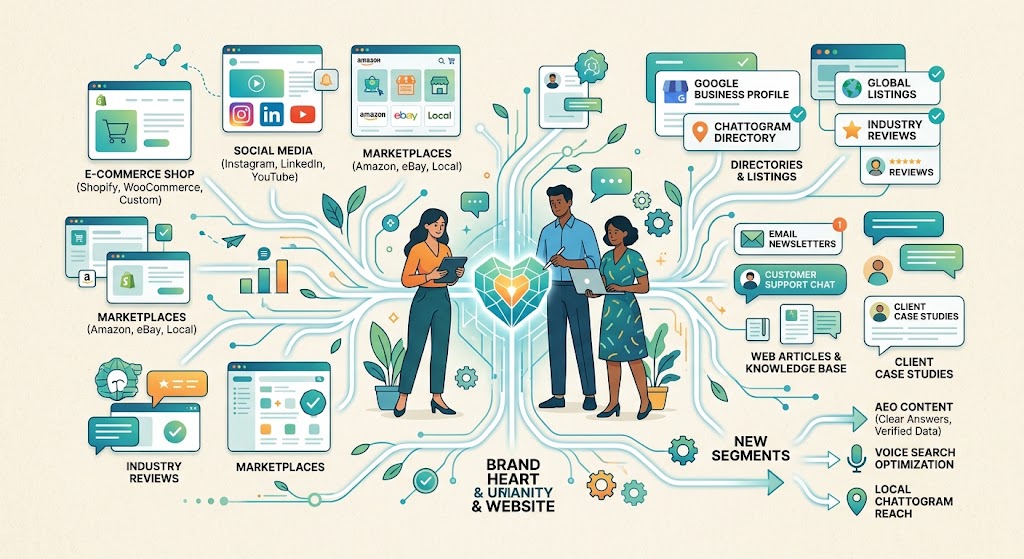
A business may have excellent content on its website, but its wider online presence also affects how customers discover and evaluate it.
Consider a company searching for a supplier to handle an important project. It finds a business website with a detailed service page and a few impressive portfolio images.
That is a good starting point, but the company may want to verify the business before making contact.
It might look for client reviews, examples of completed projects, professional profiles, mentions on industry websites, or information about the team.
This is normal buying behaviour. People rarely base important decisions on a single marketing page.
Answer engines can also retrieve information from different sources, depending on the platform and the question. As a result, a company's wider presence can contribute to how its expertise and identity are understood.
Build a consistent picture of your business
Start with the basic facts.
Is your business name consistent across your website and professional profiles? Are your services described accurately? Do your public business details match? Are your team members and project examples presented clearly?
These may sound like ordinary brand management tasks, but they help reduce confusion.
For businesses serving specific locations, accurate local information can also be important. Keep relevant business listings up to date and make sure your website clearly explains which areas you serve.
For an agency serving international clients, it may be useful to explain the markets, industries, and types of projects it supports rather than leaving visitors to make assumptions.
Earn evidence of your expertise
A company's own website is an important source of information, but independent evidence can provide additional context.
Depending on the industry, this might include genuine client testimonials, relevant industry publications, professional directories, partner listings, conference contributions, or detailed project references.
The goal is not to create as many mentions as possible.
It is to build a credible online presence that reflects the real business.
Avoid paying for fake reviews, creating misleading company profiles, or publishing large numbers of low-quality guest articles solely to make your brand appear more established.
These practices do not provide reliable evidence of expertise, and they can damage trust.
Develop content around connected topics
A single article about Shopify development may answer one question. A well-planned collection of related resources can address a much broader set of customer needs.
For example, an agency specializing in ecommerce could publish useful resources on:
Choosing between Shopify and WooCommerce.
Planning a custom Shopify theme.
Migrating an existing ecommerce store.
Integrating third-party services.
Improving storefront performance.
Maintaining an ecommerce website after launch.
Each article should have a clear purpose and provide information that is genuinely useful.
Where appropriate, link related articles to relevant service pages and project examples. This helps readers continue their research and gives the website a clearer structure.
Do not publish multiple pages that answer the same question with only minor wording changes. Focus on depth, relevance, and a clear connection to the business's actual expertise.
Keep the information current
Some topics change quickly. Platform features, software requirements, prices, regulations, and product specifications may become outdated.
Review important pages periodically and update them when the information changes. If an article contains a technical recommendation, make sure it still reflects current documentation and practice.
For an agency, keeping case studies, team information, and service descriptions accurate is equally important.
AEO is not a one-time technical implementation. It is part of maintaining a useful and trustworthy online presence.
06. How Businesses Can Measure AEO and Prepare for What Comes Next
One challenge with AEO is deciding whether the work is producing useful results.
Traditional SEO offers familiar metrics such as organic clicks, impressions, rankings, and conversions. AEO introduces additional questions.
Is the business appearing in relevant AI-generated answers? Are its pages being cited? Is the information about the company accurate? Are people discovering the business through these experiences and visiting its website?
These questions require a more careful measurement process than simply checking whether a brand appears in one AI response.
Start by identifying the questions that matter to your business
Create a list of realistic questions a potential customer might ask when researching your services.
For a web development agency, examples might include:
Which agencies build custom Shopify stores?
What should a business consider before choosing a Shopify development partner?
How much does a custom ecommerce website cost?
What is involved in migrating a store to another platform?
Which technologies are suitable for a particular type of web application?
The questions should reflect your services, audience, and market.
Avoid testing only broad questions such as "What is web development?" Those may be useful for content planning, but they do not necessarily reveal whether your business is visible for questions that could lead to a real enquiry.
Establish a baseline
Test the selected questions across the answer engines that matter to your audience.
Record whether your business appears, whether your website is cited, which competing businesses are mentioned, and whether the information is accurate.
Because results can vary between prompts, platforms, locations, and dates, a single test is not enough to establish a reliable trend.
Repeat the checks periodically and keep the testing method consistent.
Do not treat the results as a perfect measurement of your overall visibility. AI responses can change, and different users may receive different answers.
Track website traffic and business outcomes
Use Google Search Console to review search impressions, clicks, and relevant query trends. Use your website analytics to monitor organic landing pages, referral traffic where available, engagement, and conversions.
If an answer engine sends visitors to your website and the referral information is available, track that traffic separately.
It is also useful to ask new leads how they discovered your company. Some visitors may learn about a business through an AI answer and later visit its website directly, making the original discovery harder to identify through analytics alone.
For businesses with longer sales cycles, track qualified enquiries and the opportunities they generate rather than relying only on traffic.
The purpose is to understand whether the work improves visibility among the right audience and supports real business goals.
A practical 90-day starting plan
Businesses do not need to rebuild their entire website to begin improving their AEO readiness. A focused plan can help identify the most important gaps first.
Days 1–30: Review the current position
Audit your most important service and product pages.
Check crawling, indexing, internal links, and technical issues.
Identify the main questions customers ask before making a decision.
Establish a baseline for relevant AI-generated answers and existing organic traffic.
Check that your company information and important project details are accurate.
Days 31–60: Improve the most important pages
Rewrite vague service descriptions to explain actual capabilities.
Add useful answers to common customer questions.
Improve relevant case studies with real project details.
Publish one or two substantial resources addressing important customer decisions.
Review structured data and other technical elements where relevant.
Days 61–90: Evaluate and refine
Recheck your selected questions across relevant answer engines.
Review search performance and available referral data.
Identify which pages are attracting relevant visitors.
Check for inaccurate brand information or missing evidence.
Use the findings to prioritize the next round of improvements.
This timeline is a practical starting point, not a promise of results within 90 days. Search visibility depends on many factors, and improvements may take longer to appear.
The key is to build a process that can be reviewed and improved over time.
The future of search is not just about getting mentioned by AI
It is tempting to treat AEO as a competition to get a company name into as many AI answers as possible.
But visibility by itself is not the final goal.
A business needs to be visible for relevant questions, communicate its value accurately, and give potential customers a reason to trust it.
An AI system mentioning a company for the wrong service or market may not create any meaningful business opportunity. A relevant citation that brings a well-informed prospect to the right page can be far more valuable.
This is why AEO should be connected to the wider customer journey.
The website must explain the business. The content must answer real questions. The project examples must demonstrate relevant experience. The contact process must make it easy for interested visitors to take the next step.
As search continues to evolve, these fundamentals will remain important.
How Grayshaper Approaches AEO
At Grayshaper, we believe a website should do more than look professional. It should explain the business clearly, support its marketing goals, and help the right people understand what it offers.
That starts with the website itself.
We look at how services are presented, how important information is organized, how pages connect, and whether the content answers the questions potential customers are likely to ask.
We also consider the technical side, including crawlability, page structure, performance, internal linking, and structured data where appropriate.
But technical implementation is only one part of the work. A well-built website still needs useful content, clear positioning, and evidence that supports its claims.
For businesses looking to improve their visibility in AI-powered search, we see AEO as part of a broader strategy that connects website development, content, technical SEO, and brand credibility.
There is no honest way to guarantee that an answer engine will recommend a particular business. What we can do is help build a stronger foundation: a website that communicates its expertise clearly, provides useful information, and gives search systems and potential customers a better understanding of the business.
That is a more sustainable approach than chasing a new tactic every time the search landscape changes.
Final Thoughts: Build a Website Worth Citing
The way people discover businesses is changing, but the underlying need remains the same.
People want useful information. They want to understand their options. And when they are making an important decision, they want evidence that the business they choose can deliver what it promises.
AEO gives businesses another reason to take those needs seriously.
It encourages them to move beyond vague marketing language, answer real customer questions, present their expertise clearly, and maintain an accurate online presence.
It also reminds us that search visibility is not only about a position on a results page. In some situations, it is about whether a business becomes a relevant source in the answer someone receives.
No technique can guarantee that outcome. AI systems differ, and their results change over time. But businesses can take meaningful steps to make their information more accessible, useful, and trustworthy.
The objective is not simply to make your website visible to answer engines. It is to give them, and the people using them, a clear reason to consider your business a relevant source.
That is where a thoughtful AEO strategy begins.
Frequently Asked Questions About AEO
What is Answer Engine Optimization (AEO)?
Answer Engine Optimization is the practice of improving a website's content and online presence so that answer engines can find, understand, and potentially use its information when responding to relevant questions. It builds on traditional SEO and focuses on visibility in direct answers, including those generated by AI-powered search experiences.
What is the difference between SEO and AEO?
SEO generally focuses on improving a website's visibility in search results. AEO places additional emphasis on making information useful and accessible to systems that provide direct answers. The two overlap significantly, and strong technical SEO and helpful content remain important for both.
Does AEO help a website appear in ChatGPT or Google AI Overviews?
AEO practices can help make a website's information clearer and easier to retrieve, but they do not guarantee inclusion in AI-generated answers. Each platform uses its own systems, and results can change depending on the question and available sources.
Is schema markup necessary for AEO?
Schema markup can help describe relevant information in a structured format, but it is not a universal requirement for AEO. Google states that no special schema markup is required to appear in AI Overviews or AI Mode. Structured data should be accurate, relevant, and consistent with the visible content.
How long does AEO take to show results?
There is no fixed timeline. Results depend on the website's existing condition, the competition, the quality of the improvements, and how answer engines retrieve and present information. A business should monitor changes over time rather than expect guaranteed visibility within a specific number of days.
How can a business measure AEO performance?
Businesses can monitor whether they appear in relevant AI-generated answers, whether their pages are cited, how their organic search performance changes, and whether relevant referral visits or qualified enquiries increase. Testing should be repeated consistently because answer engine results can vary.
Can small businesses benefit from AEO?
Yes. Small businesses can benefit by explaining their services clearly, answering customer questions, publishing useful original content, maintaining accurate business information, and demonstrating their experience through real examples. These improvements also support traditional SEO and help potential customers make informed decisions.
Does AEO replace traditional SEO?
No. AEO complements SEO rather than replacing it. Crawlability, indexing, helpful content, internal linking, website usability, and other established SEO practices remain important foundations for search visibility.
Suggested further reading