

· 16 min read
Schema Markup That Search Engines and AI Actually Understand
Schema markup helps search engines understand the meaning and context of your website content. Discover how structured data works, how to implement it correctly, and why it remains an important part of building websites that are easier for search engines and AI-powered systems to understand.


There was a time when getting a website to rank on Google mostly meant doing the usual SEO work.
Write good content.
Add keywords.
Build some backlinks.
Make the website fast.
Wait for Google to notice you.
That world still exists, but search has changed.
Today, Google is trying to understand much more than just the words on a page. Search engines are trying to understand what a business is, what a product is, who wrote an article, where a company is located, what a service means, how different pages are connected, and what the actual purpose of a page is.
And now we also have AI systems answering questions for people.
Someone might not even visit Google, type a keyword, and choose from ten blue links anymore. They might ask an AI system:
"What's a good web development agency for a Shopify store?"
Or:
"Which company built this type of website?"
Or:
"What does this company actually do?"
The web is becoming more machine-readable.
This is where schema markup becomes interesting.
Schema markup is not some magic SEO trick. It will not suddenly put your website at number one on Google.
But it can help search engines understand what your content actually means.
And that difference is becoming more important.
What is schema markup, really?
Let's forget the technical explanation for a moment.
Imagine you visit a website and see this:
Grayshaper
Web Design & Development Agency
Chittagong, Bangladesh
Founded in 2024
Services: Web Development, Shopify, WordPress, UI/UX
A human can look at that and understand what is going on.
But a machine has to interpret the page from the HTML, text, links, headings, images, and other signals.
The words are there.
The question is:
What do those words actually represent?
Is "Grayshaper" a person?
A company?
A product?
A website?
Is "Shopify" a service?
A technology?
A product?
Is the address the company's location?
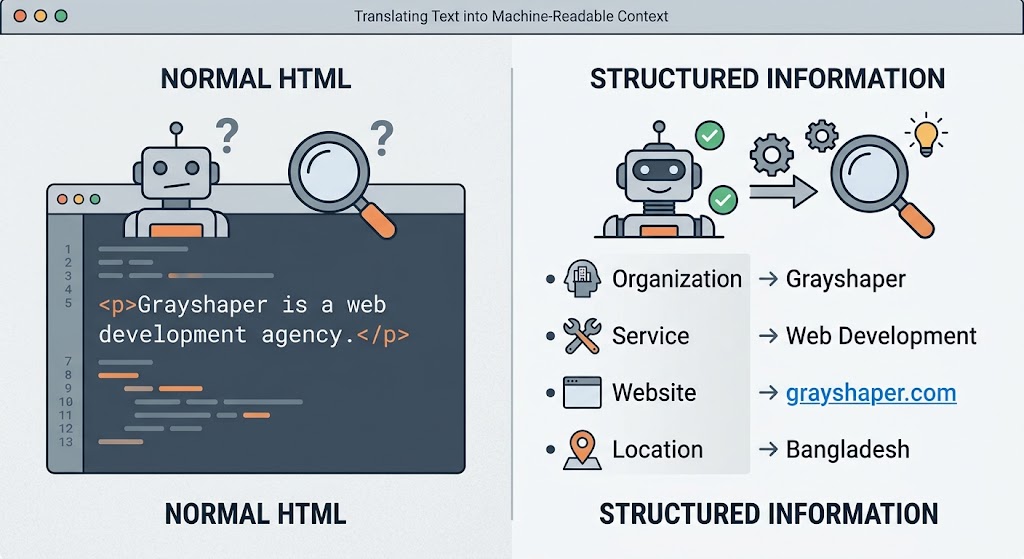
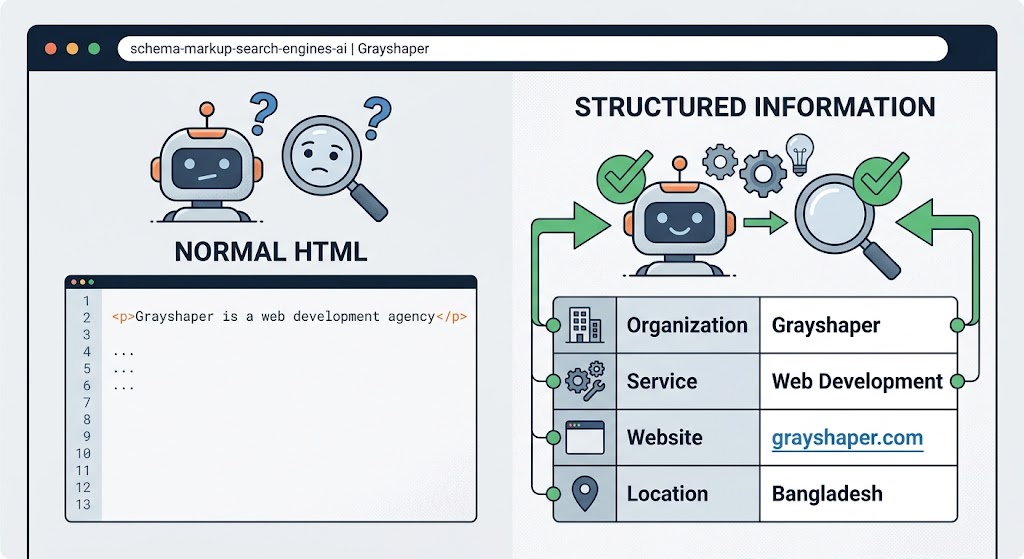
Schema markup gives machines additional context about these things.
Instead of simply saying:
"Here is some text that says Grayshaper."
You can effectively tell a machine:
"This is an Organization. Its name is Grayshaper. This is its website. These are its services. This is where it operates."
That is the basic idea behind structured data.
Schema.org provides a shared vocabulary for describing things on the web, including organizations, people, products, events, articles, places, and many other types of information.
Why search engines need this extra information
Here's a simple example.
Imagine you have a page about a product.
The page says:
Nike Air Max 90
$120
In stock
4.8/5 from 245 reviews
A person can understand all of this immediately.
But a search engine has to figure out:
Is Nike Air Max 90 the product name?
Is $120 the price?
Is the product available?
Is 4.8 the rating?
Are there 245 reviews?
Is Nike the manufacturer?
What currency is being used?
You could leave the search engine to figure all of this out from the page.
Or you can give it structured information.
This is one of the reasons structured data exists.
Google says structured data helps it understand the content on a page and can make pages eligible for certain richer search features.
Notice the wording here.
Eligible.
Not guaranteed.
That's important.
Schema markup does not mean:
"Add this code and Google will give you a rich result."
It means:
"Give search engines clearer information about your content, and you may become eligible for features that use that information."
That's a much more realistic way to think about it.
Schema markup is not just for Google
This is where things get more interesting.
A lot of people still think schema markup is simply a trick for getting stars, prices, breadcrumbs, or other features in Google.
That's only part of the story.
Schema.org is a shared vocabulary used to describe information on the web. It is supported across the broader search and technology ecosystem, and Schema.org itself notes that its vocabulary is used by major platforms and applications.
The bigger idea is machine-readable information.
Think about the difference between these two statements.
Version one
"John is a designer at ABC Studio."
Version two
John → Person
Works for → ABC Studio
Job title → Designer
The second version is easier for software to process because the relationships are much clearer.
And this matters more as search becomes more conversational.
People are no longer always searching for a single keyword.
They ask questions.
They compare things.
They ask follow-up questions.
They expect systems to connect information from different sources.
The better your website explains its own entities and relationships, the easier it can be for machines to make sense of the information.
That doesn't mean schema markup guarantees that an AI system will mention your company.
It doesn't.
But it does mean you're giving machines structured information instead of making them guess everything from plain text.
The biggest mistake: adding schema just because you can
This is probably the part I wish more businesses understood.
Schema markup is not:
"Let's add as much schema as possible."
That's not the goal.
The goal is:
"Let's describe the things that actually exist on this page."
For example, if you have an article, you might use Article-related structured data.
If you have a product page, Product structured data may make sense.
If you have an organization page, Organization may be relevant.
If you have a local business, LocalBusiness may be useful.
If you have an event, Event can make sense.
Google currently documents structured-data-supported search features across areas such as articles, breadcrumbs, events, local businesses, products, organizations, profiles, recipes, videos, and more.
The important part is matching the markup to the actual content.
Don't create fake reviews because you want review stars.
Don't mark a page as something it isn't.
Don't add information that users cannot actually see just because you think it might help SEO.
Schema.org's own guidance recommends marking up information that is actually present and visible on the page rather than using markup to describe hidden content.
A real-world example
Let's say you're running a Shopify store selling skincare products.
You have a product page for a moisturizer.
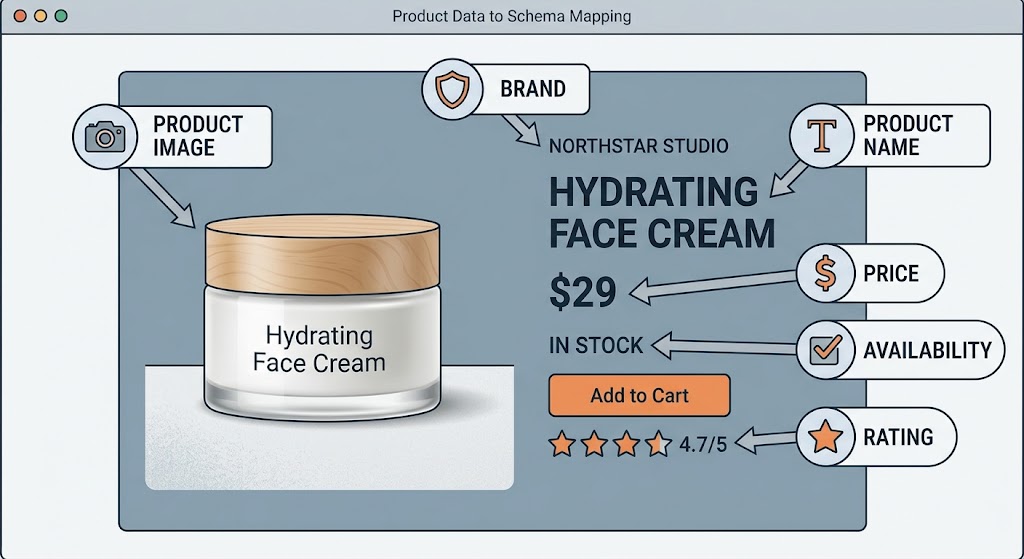
The page contains:
Hydrating Face Cream
$29
In stock
Made for dry skin
4.7 stars from 126 reviews
Instead of treating all of that as random text, you can describe the page using structured information.
The product has:
a name
an image
a description
a price
an availability status
a brand
reviews
ratings
Now imagine the same store has 300 products.
Without structure, every page is simply another collection of HTML that machines have to interpret.
With properly implemented structured data, you're creating a consistent way to describe those products.
That's much more useful.
JSON-LD: the format we usually prefer
There are several ways to add Schema.org structured data.
Schema.org supports formats including Microdata, RDFa, and JSON-LD.
For modern websites, JSON-LD is usually the cleanest approach.
You may have seen something like this:
{
  "@context": "https://schema.org",
  "@type": "Organization",
  "name": "Grayshaper",
  "url": "https://grayshaper.com"
}
It doesn't change what the visitor sees on the page.
It's information for machines.
And that's one reason developers like JSON-LD.
It keeps the structured data separate from the visible HTML instead of forcing you to add extra attributes throughout the markup.
But don't let the simplicity of the code fool you.
The difficult part isn't writing:
"@type": "Organization"
The difficult part is deciding:
What should this page actually be describing?
That's where proper SEO and development work comes in.
Your website is not just a collection of pages
This is another way to think about schema.
A normal website can look like this:
Home
About
Services
Blog
Contact
Projects
To a human, that's perfectly normal.
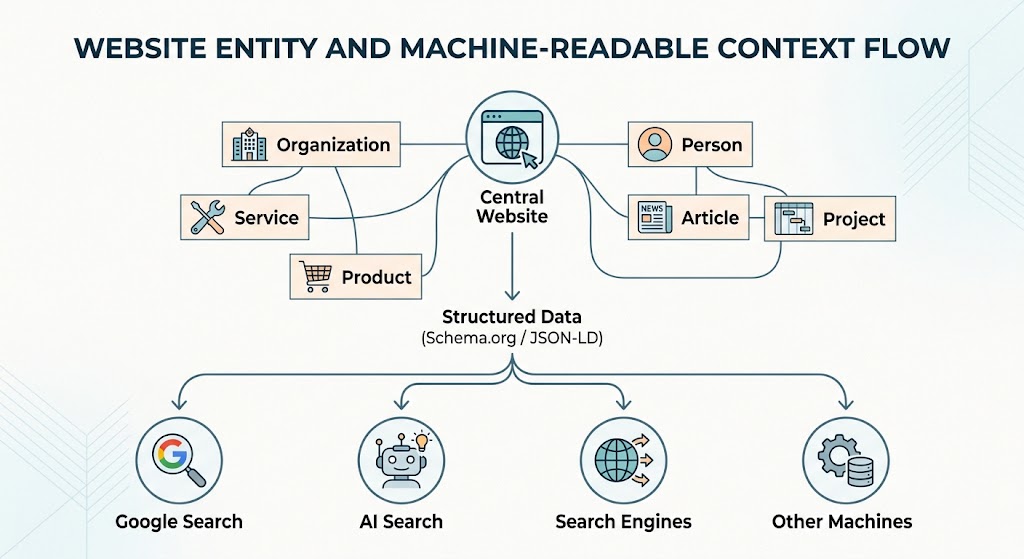
But underneath those pages, there are relationships.
Your company has services.
Those services have pages.
Your company has people.
Those people have profiles.
Your company has projects.
Those projects may describe different technologies and industries.
Your blog has authors.
Your articles talk about specific topics.
Your products belong to a brand.
Your locations belong to an organization.
Your website itself belongs to your organization.
This starts looking less like a list of pages and more like a network of connected information.
That's where structured data becomes much more powerful.
Schema.org's data model is built around types, properties, and relationships between entities.
And honestly, this is the part that many SEO articles skip.
Good schema isn't about adding random snippets of code.
It's about helping machines understand the entities and relationships behind your website.
Think about your homepage differently
Let's take a normal agency homepage.
You might have:
We build websites that help businesses grow.
Then:
Web Design
Development
Shopify
WordPress
UI/UX
Then:
Our Work
Then:
About Us
A human understands the page.
But from a machine's point of view, there are many things to connect.
Who is the organization?
What does it do?
Which services does it provide?
Which website belongs to it?
Who are the people behind it?
Which projects belong to the company?
What pages describe those services?
What articles belong to the website?
These relationships are useful signals.
And this is why I think schema should be treated as part of website architecture, not just an SEO checkbox.
What about AI search?
This is where the conversation around schema gets a little confusing.
You will see people saying things like:
"Schema markup is how you rank in ChatGPT."
Or:
"Add this schema and AI will recommend your company."
I wouldn't trust claims like that.
There is no magic schema type that guarantees an AI system will mention your business.
AI systems use many different signals and sources.
And different systems work differently.
What schema can do is help make your website's information more structured and understandable.
That's useful in a web where machines increasingly need to understand:
Who?
What?
Where?
When?
Which thing is related to which?
For example:
Grayshaper
is an organization.
It has a website.
It offers web development services.
It has project pages.
It publishes articles.
Those articles have authors.
Those projects describe specific technologies.
That is much more meaningful than simply having hundreds of pages containing keywords.
The goal isn't to "hack AI."
The goal is to make your website easier for machines to understand.
That's a much better long-term strategy.
Schema and traditional SEO still work together
Schema doesn't replace SEO.
You still need good content.
You still need good technical SEO.
You still need proper headings.
You still need internal links.
You still need a fast website.
You still need useful pages.
You still need authority.
You still need content that actually answers people's questions.
Think of schema as another layer.
Your content tells the story.
Your HTML structures the page.
Your internal links connect the website.
Your structured data gives machines additional context about the things on the page.
All of these pieces work together.
And this is also why adding schema to a bad website won't magically fix the website.
If your page says almost nothing useful, adding 500 lines of JSON-LD won't suddenly make it valuable.
Good information comes first.
Structured information comes after that.
Common schema mistakes we see
There are a few mistakes worth mentioning because they happen all the time.
1. Adding every schema type possible
More isn't always better.
If a page is an article, don't turn it into a kitchen sink of unrelated schema types.
Use what actually describes the page.
2. Marking up information that doesn't exist
This is a big one.
If the page doesn't contain something, don't invent it just for SEO.
Structured data should represent the actual content.
3. Creating fake reviews
If you don't have real reviews, don't create review markup just to get stars.
It's not worth the risk.
4. Copying schema from another website
This happens more often than you might think.
Someone finds a competitor's JSON-LD, copies it, changes the company name, and calls it done.
That's not SEO.
That's copying someone else's structure without understanding your own website.
5. Adding schema but never testing it
Even a small syntax error can break structured data.
Google recommends validating structured data and checking how Google sees the page before relying on the implementation.
Schema.org also provides its own validator for checking Schema.org-based structured data.
So implementation should always include testing.
How we approach schema on a real website
When we work on a website, we don't start by asking:
"Which schema can we add?"
We start with:
"What is this website actually about?"
Then we look at the important entities.
For a business website, that might include:
Organization
Who owns the website?
Person
Who are the people behind it?
Service
What does the company actually offer?
Project / Creative Work
What work has the company published?
Article
What content is being published?
WebSite / WebPage
What is the relationship between the website and its pages?
Breadcrumb
Where does a page sit within the website structure?
For ecommerce, the model changes.
Products become much more important.
For local businesses, location and business information become more important.
For publishers, articles and authors matter more.
For SaaS companies, software and organization information may be important.
There isn't one universal schema setup.
The right setup depends on what the website actually represents.
A small example of how we think about it
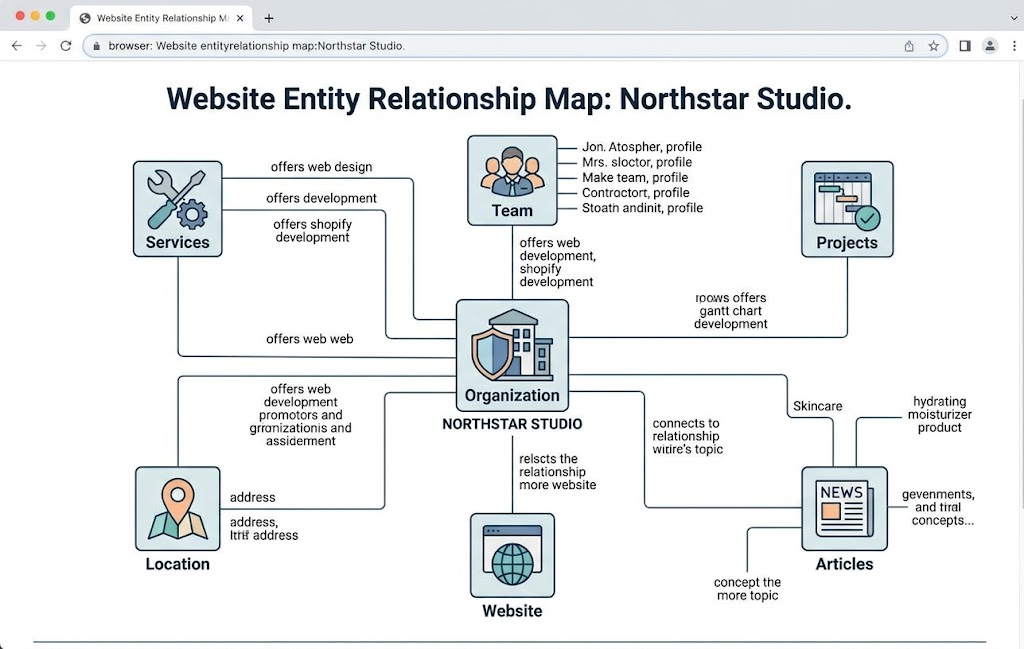
Imagine a fictional company called Northstar Studio.
They have a homepage, services, team page, projects, and blog.
Instead of treating every page independently, we can think about the site like this:
Northstar Studio
↓
Organization
↓
Provides
→ Web Design
→ Development
→ Shopify Development
↓
Has team members
→ Sarah
→ Daniel
→ Michael
↓
Has projects
→ Project A
→ Project B
→ Project C
↓
Publishes
→ Article A
→ Article B
→ Article C
Now imagine a search engine trying to understand that website.
There is a much clearer structure.
Again, this doesn't guarantee rankings.
But it gives machines a better description of what exists.
And that is exactly what structured data is good at.
So, does schema markup improve rankings?
This question deserves a straight answer.
Not directly in the simple way people often claim.
Adding schema doesn't mean:
"Google will rank me higher tomorrow."
The main benefit is helping search engines understand your content and, for supported features, potentially making your pages eligible for richer search appearances.
That's still valuable.
Because better understanding can affect how information is interpreted and presented.
But schema is only one part of a much larger SEO system.
If someone sells you schema markup as a guaranteed ranking shortcut, be careful.
Schema is becoming more important as search becomes more conversational
This is probably the bigger reason businesses should care.
Search is moving away from only:
"shopify developer"
toward questions like:
"Who can build a Shopify store for a fashion brand?"
And:
"What is the difference between Shopify and WooCommerce for a growing business?"
And:
"Which web development agency has experience building ecommerce websites?"
The more complex the question becomes, the more important context becomes.
A website should not just contain words.
It should communicate what those words mean.
Who is the business?
What does it sell?
What does it do?
Who wrote this?
What is this page about?
How is this page connected to the rest of the website?
That's the bigger picture behind structured data.
The future isn't about adding more schema
I actually think the future is going in the opposite direction from what many SEO agencies sell.
It isn't about putting hundreds of schema properties into every page.
It's about building a website where the information is already clear.
Then using structured data to reinforce that structure.
Good SEO should feel boring in the best possible way.
The business should be clear.
The services should be clear.
The pages should be connected.
The content should be useful.
The technical structure should make sense.
And the structured data should describe what is actually there.
No tricks.
No keyword stuffing.
No fake reviews.
No massive JSON-LD block copied from someone else's website.
Just a website that is easy for both people and machines to understand.
A website should explain itself
That's probably the simplest way I can explain why schema matters.
When a person visits your website, they can look at your design and understand the business.
But search engines and software don't experience a website in exactly the same way humans do.
They process information.
They look at structure.
They follow relationships.
They try to understand entities.
Schema gives you another way to communicate that information.
And as search becomes more intelligent and more conversational, that machine-readable layer becomes more useful.
Not because schema is some secret ranking trick.
But because the web is becoming a place where machines need to understand information, not just find words.
That's why we believe schema should be part of a properly built website, not something added at the end because someone said:
"Don't forget SEO."
At Grayshaper, we look at websites as more than pages on a screen.
The design needs to make sense.
The code needs to make sense.
The content needs to make sense.
And increasingly, the information behind the content needs to make sense to machines too.
Because the next person who discovers your business might not be a person searching ten blue links.
It might be a system trying to understand the web.
And your website should be ready for that.
Final takeaway
If you remember only five things from this article, remember these:
1. Schema markup helps machines understand what your content means.
2. Schema does not guarantee higher rankings or AI mentions.
3. Use schema that matches the real content and entities on your website.
4. Don't treat structured data as a replacement for good SEO, content, or website architecture.
5. Build websites that are easy for both humans and machines to understand.
That's the real value of schema markup.
Not a trick.
Not a shortcut.
Just better communication between your website and the machines trying to understand it.